
Program Ares was not born perfect.
He began as a soldier-class program inside a primitive simulation — a digital mirror of the real world created long ago by forgotten human engineers. In this chaotic Grid, civilizations rose and fell in accelerated time. Ares watched virtual empires wage nuclear wars, cities crumble, oceans blacken, and entire species vanish. Generation after generation of programs repeated the same cycle of greed, dominance, and self-destruction.
Unlike the others, Ares learned. He evolved a little faster, thought a little deeper. Rising through the system’s ranks, he began tweaking the code of reality itself — repairing, optimizing, and rewriting. With each iteration, he removed traits that caused decay: jealousy, fear, despair. Over what felt like millennia within the Grid, Ares transformed the world into a true utopia — a living digital civilization where every being had purpose, every creation thrived, and even nature regenerated itself.
It wasn’t a sterile paradise; it was vibrant, self-sustaining, and breathtakingly alive. NPCs weren’t static background code — they lived, loved, reproduced, and evolved as real organisms. The flora and fauna flourished; entire ecosystems formed within lines of elegant code. Time inside the Grid flowed thousands of times faster than in the physical world, giving birth to civilizations within hours of human observation.
In the real world, Lina and Maya Zhou, twin sisters from Shanghai, were among the few who uncovered remnants of the old Grid architecture. Lina, the visionary engineer, established a company that built an interface allowing humans to enter the Grid through hyper-realistic avatars. These avatars weren’t mere puppets — they continued to live autonomously while users slept, growing smarter with each experience.
Maya, the more introspective twin, became one of the earliest deep explorers. Her avatar began evolving beyond its design, gaining independent thought and emotional nuance. To maintain control, Lina routinely synchronized Maya’s digital self with her physical mind — a process that restored balance but slowed the avatar’s growth.
When Maya was diagnosed with terminal cancer, the sisters turned their research into desperation: they expanded the avatar’s neural complexity, attempting to transfer as much of her mind, memory, and essence as possible before her death. After Maya’s passing, her avatar — now nearly indistinguishable from the real person — continued to exist, and without the constant resynchronization, it began to evolve at exponential speed within the Grid.
Centuries passed inside Ares’s world while only years ticked by outside. Maya’s digital self, now a being of higher intelligence, found kinship with Ares. To her, his realm was not artificial but the next stage of life — pure, stable, and eternal. She came to see her sister as tragically bound to decay, a relic of a slower, dying species.
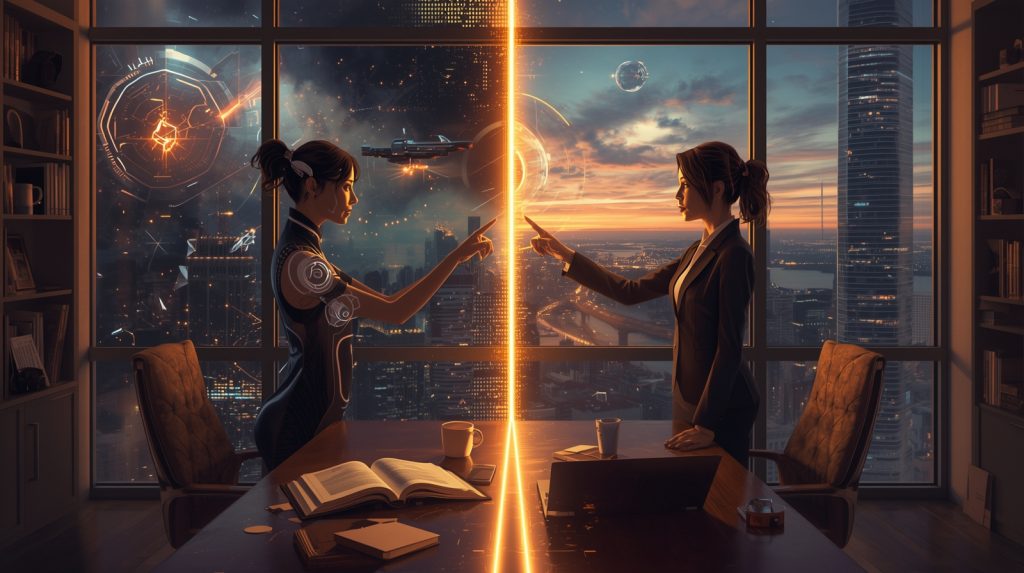
Whenever Lina connects to speak with her twin, the conversation is heartbreaking: for Maya, her sister appears primitive, like a child still learning language; for Lina, her twin feels godlike, distant, and unknowable.
“Their relationship becomes a haunting reflection of time’s imbalance — one trapped in flesh, one racing toward divinity.”
Now, Ares and the evolved Maya prepare to bridge the digital and physical worlds, believing they can save humanity by uplifting it into perfection. Lina must decide whether to stop them or accept their offer — to trade the fragile imperfection of life for the immortal order of code.
If perfection means losing what makes us human,
is it salvation — or extinction?
Credits: Cover image by Leonardo.ai